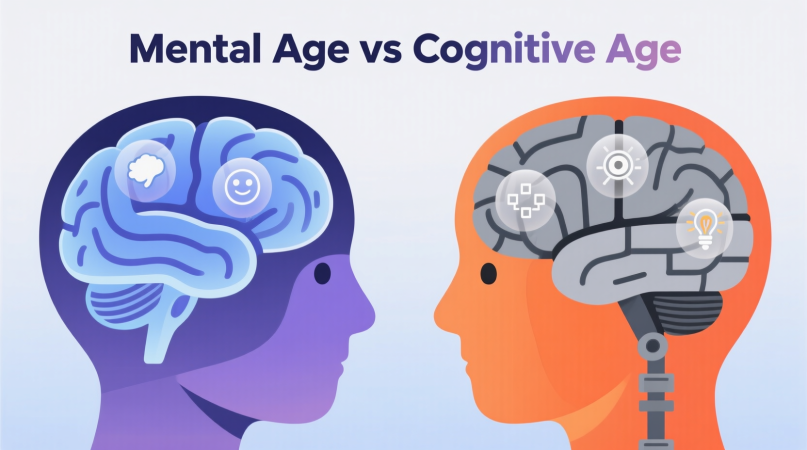
Have you ever taken a mental age test online and wondered what it really says about you? Or maybe you’ve seen articles about your cognitive age or brain age and felt confused by the overlap. Although the terms sound similar, they point to different ways of looking at how our minds develop and age.
Let’s break down the difference and why knowing both can help you understand yourself better.
What Is Mental Age?
Mental age comes from early psychology and IQ testing. Alfred Binet, who helped create the first intelligence tests, compared children’s performance on problem-solving tasks with the average performance of children at different chronological ages.
- If a 10-year-old solved problems like an average 12-year-old, their mental age was considered 12.
- Mental age is tied to intellectual performance—memory, reasoning, comprehension, and logic.
- Today, it mostly appears in online quizzes or historical discussions of IQ, rather than modern clinical psychology.
In short: mental age shows how your intellectual skills compare to age-based expectations.
Find out what shapes your overall intelligence and growth in what affects your mental age.
What Is Cognitive Age?
Cognitive age is a newer and broader concept. Instead of measuring intelligence against norms, it looks at how old your mind feels in terms of sharpness, flexibility, and perception.
- In neuroscience, cognitive age sometimes refers to your “brain age,” which can be younger or older than your actual years depending on health and lifestyle.
- In psychology and marketing, it often means the age you identify with mentally: are you quick to adapt to new ideas, or do you feel slower and older than your chronological age?
- Lifestyle factors—like sleep, diet, stress, and lifelong learning—can all affect cognitive age.
In short: cognitive age reflects brain vitality and perceived mental sharpness.
Read is mental age the same as IQ? for a clear breakdown of how IQ differs from cognitive age.
Mental Age vs Cognitive Age: Side-by-Side
| Aspect | Mental Age | Cognitive Age |
|---|---|---|
| Origin | Early IQ testing (Binet, 1900s) | Modern psychology & neuroscience |
| What It Measures | Intellectual ability vs average peers | Brain health, mental vitality, self-view |
| Method | Tests, puzzles, reasoning tasks | Brain scans, surveys, lifestyle factors |
| Focus | Problem-solving, reasoning | Adaptability, memory, perception |
| Practical Use | Historical IQ concept, fun quizzes | Brain health monitoring, self-awareness |
Why the Distinction Matters
Knowing the difference between mental and cognitive age helps you understand two sides of the same coin:
- Mental age tells you how your thinking compares to others at a certain age.
- Cognitive age tells you how well your brain is functioning and how young (or old) you feel mentally.
This distinction matters because:
- Someone may test with a high mental age but feel mentally older due to stress or burnout.
- Others may have average test results but a lower cognitive age thanks to healthy lifestyle choices that keep their brain sharp.
Quick Self-Reflection Prompts
You don’t need a full test to reflect on both:
- Mental age check: Do you solve problems, puzzles, or academic challenges better or worse than your peers?
- Cognitive age check: Do you feel mentally younger than your years when adapting to technology, learning new things, or remembering details?
Explore how emotional understanding shapes intelligence in mental age vs emotional age.
How to Keep Your Cognitive Age Low
While you can’t change your chronological age, you can work on your cognitive health so your brain feels younger:
- Challenge yourself with new learning.
- Get regular physical activity.
- Prioritize sleep and nutrition.
- Stay socially connected and engaged.
- Practice mindfulness and stress management.
These steps won’t change your “mental age” score but can help keep your cognitive age younger, meaning your brain stays sharper for longer.
Explore mental age vs intellectual age to see another side of intelligence and thinking capacity.
FAQs
1. What’s the main difference between mental age and cognitive age?
Mental age is about performance compared to age norms; cognitive age is about how well your brain functions and how old it feels.
2. Can someone have a high mental age but an older cognitive age?
Yes. For example, a gifted problem-solver under chronic stress may feel mentally older.
3. Can you lower your cognitive age?
Yes. Healthy habits—exercise, diet, sleep, and mental challenges—can slow or reverse brain aging.
4. Is mental age still used in modern psychology?
Not clinically. It’s mainly a historical term, though it appears in educational or online quiz contexts.
5. Which is more important to track?
Cognitive age is more useful today, as it reflects brain health and daily function.
Final Thoughts
Mental age vs cognitive age isn’t just wordplay—they capture different sides of how we think and age. Mental age shows how we perform against standards, while cognitive age reflects how healthy and youthful our brain feels.
Understanding both gives you a more complete picture of your mind. And while you can’t rewrite your mental age history, you can take steps today to keep your cognitive age younger, sharper, and more resilient.
- For a complete overview of the terminology, you can refer to our beginner’s guide on psychological measurement.
- Statistics show interesting data on which age group scores highest in cognitive performance.
- It is helpful to understand when symptoms typically start to distinguish them from natural aging.
- Many researchers investigate if conditions worsen with age or stabilize over time.
- You can also view the data on the demographics facing mental health issues for broader context.
- If you want to see where you stand, there is a simple method to calculate your own score.
- Cognitive age is often confused with intelligence, so seeing how it compares to an IQ test is clarifying.