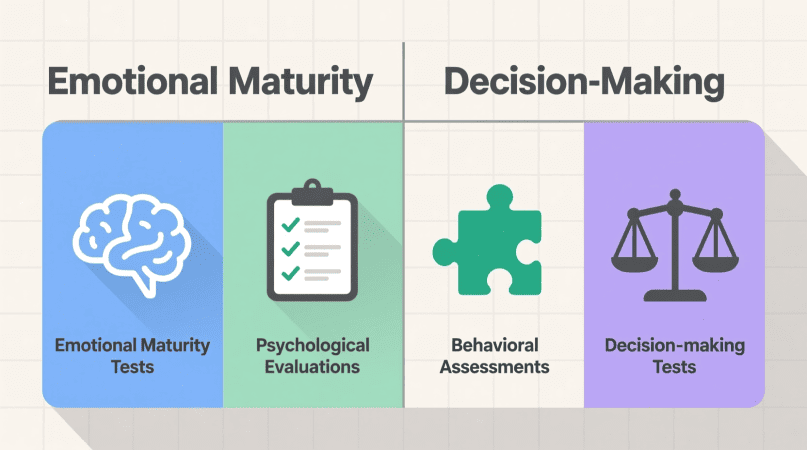
When we talk about maturity, we often describe it as something you “just see” in how someone acts. But psychologists have long asked a different question: can maturity actually be measured with a test? The answer is yes—but with important limits.
What Do We Mean by Maturity?
Maturity is more than age. It covers:
- Emotional maturity – how you regulate feelings and manage relationships.
- Mental maturity – judgment, reasoning, and long-term thinking.
- Social maturity – independence, responsibility, and adapting to norms.
Each of these can be assessed with different types of tests.
Explore mental age vs maturity test to understand how both concepts connect and differ.
Scientific Tests That Measure Maturity
Psychologists use a range of standardized tools:
- Washington University Sentence Completion Test (WUSCT): Assesses ego development by analyzing how people complete unfinished sentences.
- Vineland Social Maturity Scale: Looks at independence, responsibility, and social competence.
- MSCEIT (Mayer-Salovey-Caruso Emotional Intelligence Test): Measures how well you perceive, use, and regulate emotions.
- TEIQue (Trait Emotional Intelligence Questionnaire): Evaluates traits like empathy, stress management, and adaptability.
These tests are often used in research or clinical settings, and while they’re more formal than online quizzes, they give a structured way to assess aspects of maturity.
Learn the science behind assessing personal growth in our psychological maturity test.
Online Maturity Tests and Self-Assessments
Most people encounter maturity tests in the form of quizzes. These typically cover:
- Emotional regulation
- Accountability
- Empathy
- Long-term thinking
While not diagnostic, these tools are useful for self-reflection and spotting areas to grow.
Emotional balance also plays a role in maturity — read emotional maturity to learn more.
Can a Test Capture the Whole Picture?
Here’s the catch: maturity is multidimensional. Someone might be excellent at managing stress but struggle with financial responsibility—or vice versa. No single test can cover every dimension of maturity.
Think of tests as mirrors: they reflect tendencies and patterns, not your entire personality.
Why Maturity Tests Can Still Be Helpful
Even with limitations, maturity tests can:
- Build self-awareness about your strengths and blind spots.
- Offer feedback for growth, showing what to work on.
- Improve relationships, since maturity often shapes trust and stability.
- Challenge the myth that age alone equals maturity.
Curious about another perspective? Explore your mental maturity test to see how your thinking style aligns with life’s challenges.
FAQs
Q: Are maturity tests scientifically valid?
Some, like the WUSCT or MSCEIT, are validated psychological tools. Online quizzes are less formal but still useful for reflection.
Q: Can maturity change over time?
Yes. Experience, reflection, and effort can strengthen maturity at any age.
Q: Is maturity the same as emotional intelligence?
Not quite. Emotional intelligence is part of maturity, but maturity also includes responsibility, social competence, and mental growth.
- The concept of maturity testing is explained in can maturity be measured with a test.
- How emotional development is evaluated is described in emotional maturity.
- The structure behind assessments is detailed in our methodology.
- You can experience a real assessment using the mentalagetest.
- How maturity compares to intelligence is discussed in mental age vs intellectual age.
- The meaning of your outcome is explained in results.