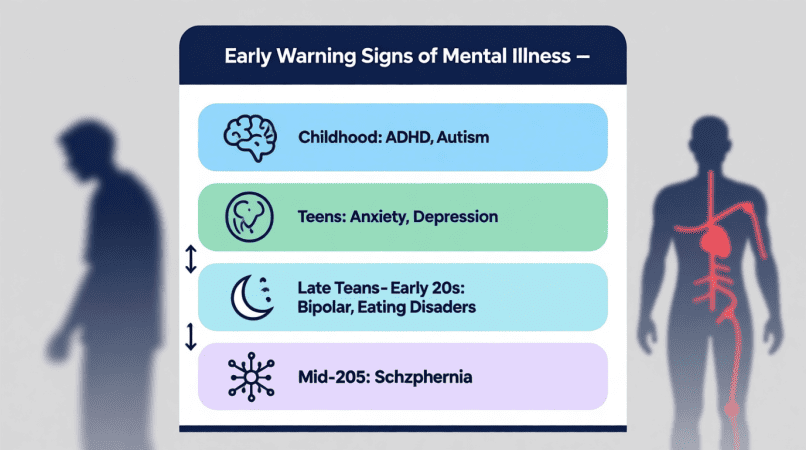
Many people assume mental illness begins later in life, but research shows that most conditions start much earlier—often in childhood or adolescence. Understanding the typical ages of onset can help parents, educators, and individuals recognize early signs and get the right support before problems become harder to manage.
Take our mental age test free to explore how mental well-being and mindset relate to your age.
Global Data: When Do Mental Illnesses Usually Begin?
- About 50% of all lifetime mental illnesses begin by age 14.
- Roughly 75% start by age 24.
- Only a minority of mental illnesses first appear after age 30.
These statistics, supported by large-scale studies, highlight why early recognition and treatment are so important.
Explore what age group has the most mental health issues to see how age affects mental health prevalence.
Common Age of Onset by Disorder
Different mental health conditions have different timelines. Here’s a quick breakdown:
Anxiety Disorders
- Often begin in childhood or early teens.
- Phobias and separation anxiety may appear as early as age 7–10.
Depression
- More common in late teens to mid-20s.
- Can also appear earlier, especially when combined with trauma or stress.
Bipolar Disorder
- Typically starts in the late teens or early adulthood.
- Early symptoms may be misdiagnosed as depression.
Schizophrenia
- Usually develops in the late teens to early 30s.
- Men often experience onset earlier (late teens to early 20s) than women (20s to early 30s).
Obsessive-Compulsive Disorder (OCD)
- Can begin in childhood, but many cases appear around adolescence.
Neurodevelopmental Disorders
- ADHD, autism spectrum disorder, and conduct disorders typically emerge in early childhood.
Read does mental illness get worse with age? for insights into how symptoms can change over time.
Early or Subclinical Signs
Sometimes, symptoms don’t meet the full criteria for a diagnosis but show up as warning signs. These can include:
- Sudden withdrawal from friends or family.
- Changes in sleep, appetite, or school performance.
- Extreme mood swings or irritability.
- Trouble concentrating or handling stress.
Recognizing these early patterns can help prevent worsening symptoms later.
Compare different stages of growth in our age ranges overview.
Factors That Influence Onset Age
- Genetics: Family history increases the likelihood of earlier onset.
- Environment: Trauma, abuse, or neglect can trigger earlier symptoms.
- Socioeconomics: Stress and lack of access to healthcare may speed onset.
- Gender: Some disorders (like depression and anxiety) are more common in young women, while schizophrenia often starts earlier in men.
Why Early Recognition Matters
The earlier a condition is identified, the better the chances of recovery. Early intervention can:
- Reduce the severity of future episodes.
- Improve school or work performance.
- Strengthen relationships and social functioning.
- Prevent co-occurring issues like substance use disorders.
Explore how mental illness changes with age and why early awareness matters.
FAQs About the Age of Onset
1. What age do most mental illnesses start?
Around half start by age 14, and three-quarters by age 24.
2. Which mental illnesses often start in childhood?
Anxiety disorders, ADHD, autism spectrum disorder, and some forms of OCD.
3. Can mental illness begin in adulthood?
Yes, but it is less common. Examples include post-traumatic stress disorder (PTSD) or late-onset depression.
4. Why does early treatment matter?
It reduces long-term severity, improves functioning, and supports healthier development.
5. Are early symptoms always a sign of mental illness?
Not always—many changes can be part of normal growth. But if they persist, it’s best to seek help.
Understanding emotional development over time is easier when you explore our overview of emotional maturity.
Many early signs become clearer when compared across different age ranges.
How people respond to stress and change is explained in our psychology guide.
Readers often check their own patterns using the mental age test for additional self-reflection.
For scientific context on how evaluations are built, our methodology page is helpful.
If you want to understand how insights are presented, review a sample on the results page.