Mental Age Test Results — Understand What Your Score Means
Congratulations on completing the Mental Age Test!
You’ve just taken an insightful step toward understanding how your emotional maturity, decision-making style, and social awareness align with different stages of human development.
This page explains how to interpret your mental age, what your result says about you, and how to improve your mindset over time.
What Does Your Mental Age Mean?
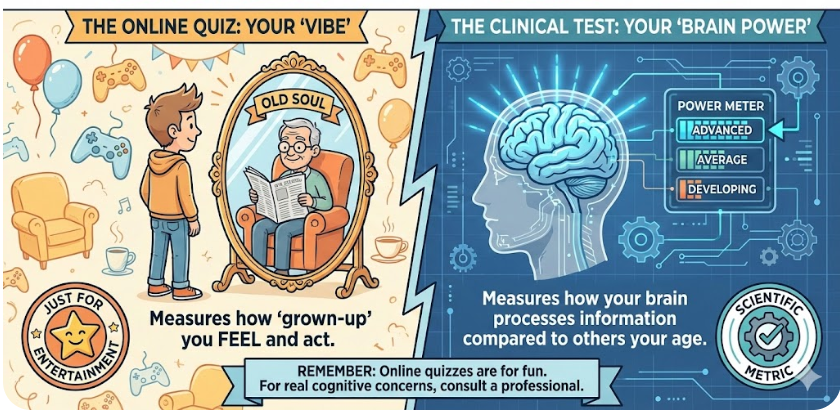
Your mental age represents how your mind thinks and reacts, not how many years you’ve lived.
It’s based on psychological dimensions such as:
- Emotional regulation — how you handle stress or change
- Decision-making — how you approach problems and logic
- Social awareness — how you connect with others
- Impulse control — how you manage sudden emotions or reactions
The test is built on modern psychology and behavioral science principles.
It’s not an IQ test or a clinical diagnosis — rather, it reflects how your mindset, empathy, and maturity work together.
👉 Learn more about our process in the Methodology page.
Mental Age Ranges & Interpretations
Your score falls into one of the five key ranges below. Each range represents a distinct mindset stage — think of it as your psychological “season of growth.”
10–15 Years — The Carefree Spirit
You have a young-at-heart and imaginative mind. You approach life playfully, full of curiosity and creativity.
You live in the moment, though sometimes overlook long-term consequences.
Strengths: Creativity, spontaneity, enthusiasm
Growth Tips: Build patience, consistency, and focus on emotional balance.
Read: What Is the Difference Between Mental Age and Chronological Age?
16–20 Years — The Emerging Adult
You’re energetic, expressive, and in a powerful stage of self-discovery. You value freedom, connection, and exploration.
Your mind is expanding — you’re learning responsibility while keeping your inner spark alive.
Strengths: Open-mindedness, adaptability, emotional growth
Growth Tips: Strengthen decision-making and resilience.
Explore: Why Is Mental Age Important?
21–27 Years — The Balanced Individual
You show emotional intelligence, stability, and self-awareness.
You balance play and responsibility, think before acting, and value meaningful connections.
Strengths: Maturity, empathy, composure, optimism
Growth Tips: Focus on deeper self-reflection and goal setting.
See: How Do I Interpret My Mental Age Test Results?
28–38 Years — The Mature Mind
You are level-headed and emotionally grounded. You approach problems logically, value harmony, and often support others.
You’ve likely faced challenges that shaped your wisdom and stability.
Strengths: Rationality, leadership, self-control
Growth Tips: Keep curiosity alive and stay adaptable.
Learn more: Mental Age vs. Emotional Age
39–50+ Years — The Wise Elder
You’ve reached deep emotional intelligence and perspective. You guide others with empathy and patience, seeing life through wisdom and understanding.
Strengths: Wisdom, self-awareness, foresight
Growth Tips: Embrace change and keep engaging with new experiences.
Read: Benefits of Taking a Mental Age Test
How Your Result Is Calculated
Your score was generated from your responses to 20 carefully designed questions across the core psychological categories above.
Each choice contributes to a weighted average that determines your mental age.
For transparency, you can learn how our test structure works in the
Methodology page and see detailed benchmarks in the
What to Do Next
Your result is a starting point — a snapshot of your mindset today.
Use it as a guide to grow emotionally, improve awareness, and evolve your mental framework.
Here’s how to continue your journey:
- Understand your category → visit the Age Ranges page.
- Develop emotional balance → follow the Improvement Guide.
- Compare your growth → check out Mental Age vs Real Age.
- Reassess over time → retake the Mental Age Test every few months.
If you want to go deeper, you can read:
- How to Improve Mental Age
- How Does Mental Age Affect Personality?
- How to Calculate Your Mental Age Scientifically
Real Experiences from Our Users
“My result was eye-opening — I realized my mindset is younger than my real age, and that’s not a bad thing!”
— Sara, 32
“The test made me reflect on how I handle emotions. I found my balance point.”
— Jason, 25
See more reflections and experiences on our Testimonials page.