Understanding your mental age isn’t about numbers — it’s about how your mind, emotions, and personality develop and respond to the world around you.
At Mental Age Checker, our test is built on a foundation of behavioral psychology, developmental theory, and emotional intelligence research, designed to help you reflect on how mature your mindset truly is.
Purpose of the Methodology
The Mental Age Test measures patterns in thinking, feeling, and decision-making across key psychological domains.
Each question aligns with principles from cognitive development, social learning, and emotional regulation — providing insights into how you process life, not just how old you are.
Our goal is to combine scientific psychology with accessible self-reflection, helping users discover:
- How they respond to challenges and stress
- How their emotions influence decisions
- How mature their social understanding is
- How balanced their impulse control and patience are
If you’re curious about your personal outcome, view your insights on the Results page.
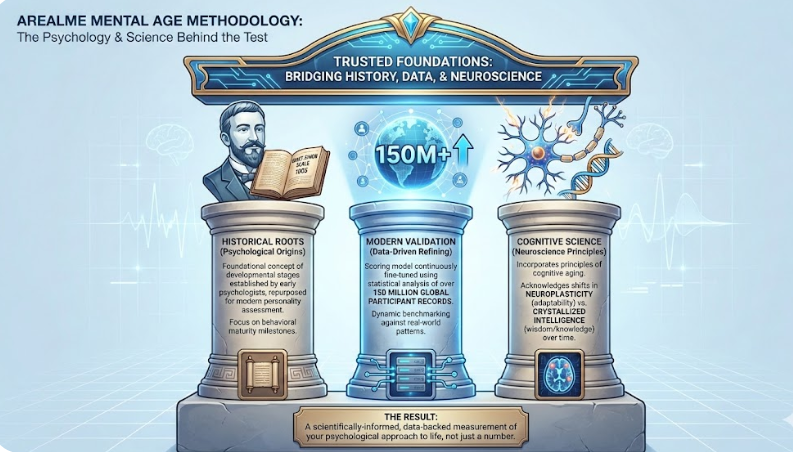
The Psychological Foundations
Our methodology is guided by several key psychological models that have shaped modern understanding of human development and emotional growth.
1. Jean Piaget’s Cognitive Development Theory
Piaget’s framework explains how humans evolve through distinct cognitive stages — from concrete to abstract thinking.
The Mental Age Test draws on his concepts of:
- Concrete operations → Younger minds focus on direct experiences
- Formal operations → Mature thinkers use logic, reasoning, and foresight
By analyzing how you interpret scenarios in the test, we gauge whether your mindset leans toward exploration, adaptability, or reflection, which helps indicate your mental age range.
Related reading: What Is the Difference Between Mental Age and Chronological Age?
2. Erik Erikson’s Psychosocial Development Theory
Erikson emphasized that people progress through eight stages of psychosocial growth, each centered on a key life challenge — from identity formation to integrity and wisdom.
The Mental Age Test reflects these principles by exploring:
- Identity vs. Role Confusion → How confident you are in your individuality
- Intimacy vs. Isolation → How you form deep, balanced relationships
- Generativity vs. Stagnation → How you seek purpose, contribution, and legacy
Your answers help us understand whether your thinking patterns resemble the youthful discovery stage or the reflective wisdom stage — mapping closely to your mental age profile.
See also: Why Is Mental Age Important?
3. Emotional Intelligence (Daniel Goleman’s Model)
Emotional intelligence (EI) measures how effectively we understand, use, and manage emotions.
Our test integrates EI research into its scoring model, focusing on four emotional competencies:
| EI Area | What It Measures |
|---|---|
| Self-awareness | Recognizing your feelings and triggers |
| Self-regulation | Controlling impulsive reactions |
| Empathy | Understanding others’ emotions |
| Social skills | Building positive, stable relationships |
Each question in the Mental Age Test subtly measures one of these areas, revealing how emotionally adaptive and mature your thinking is.
Deep dive: Ways to Improve Your Emotional Intelligence
4. Behavioral and Emotional Regulation Theories
Modern behavioral psychology emphasizes self-regulation, habit formation, and response control — concepts drawn from researchers like Albert Bandura and Walter Mischel (the “Marshmallow Test”).
Your ability to:
- Delay gratification
- Respond calmly under stress
- Adapt to unexpected change
reflects your emotional maturity, one of the core components of your mental age.
Learn more about these traits in the Improvement Guide.
How Scoring Works
Every question in the Mental Age Test is weighted according to developmental indicators.
Your answers are evaluated across four dimensions:
| Category | Measures | Related Traits |
|---|---|---|
| Emotional Regulation | How you handle stress and emotions | Calmness, reflection |
| Social Awareness | How you perceive others | Empathy, understanding |
| Decision-Making | How you approach choices | Logic, foresight |
| Impulse Control | How you manage urges | Patience, self-discipline |
The results are averaged to produce a mental age value, then matched against data-informed psychological profiles:
- 10–15 years → Explorative, imaginative mindset
- 16–20 years → Emotionally forming and adaptable
- 21–27 years → Balanced and reflective
- 28–38 years → Mature and stable
- 39+ years → Insightful, patient, wise
The Human Side of Psychology
We recognize that age and maturity don’t always align.
You might be 40 with the curiosity of a 20-year-old — or 25 with the emotional grounding of someone twice your age.
That’s why the Mental Age Checker prioritizes self-awareness over scoring.
It’s a tool for introspection — helping you see where your mind thrives and where it can grow.
How to Use This Insight
Understanding the psychology behind your result gives you the power to improve it.
You can grow your mental age by:
- Practicing emotional regulation under stress
- Building empathy and active listening
- Reflecting before reacting
- Pursuing lifelong learning and mindfulness
Ready to strengthen your mindset?
Start with our Improvement Guide and learn How to Improve Your Mental Age.
Ethical and Scientific Transparency
All insights from this test are based on academic research and validated psychological models.
However, the Mental Age Test is not a medical diagnosis — it’s a behavioral reflection tool.
For professional mental health assessments, consult a licensed psychologist.
For more, review our: