Your mental age is not fixed — it grows as you do.
This guide provides practical strategies and exercises to help you improve emotional regulation, decision-making, and social intelligence.
Whether you scored as a Carefree Spirit or a Wise Elder, these tips will help you become more emotionally balanced, self-aware, and resilient.
Why Emotional Maturity Matters
Emotional maturity shapes how you respond to stress, communicate, and form relationships.
The more emotionally intelligent you become, the closer your mental age aligns with your life experience.
To understand where you currently stand, revisit your Results page or explore how development evolves in the Age Ranges Guide.
Learn the psychology behind this framework on our Methodology page.
Emotional Regulation — Stay Calm and Centered
1. Mindful Breathing (4-6 Technique)
Take a slow breath in for 4 seconds and exhale for 6 seconds.
Repeat this cycle for one minute when you feel upset.
Why it works: It signals your brain to switch from reaction to reflection mode.
2. Name and Reframe
When emotion rises, say: “I’m feeling angry / anxious / excited.”
Naming emotions creates distance and lets logic return.
3. Mood Tracking Journal
Note your biggest emotion of the day, what triggered it, and how you responded.
Over time, you’ll identify triggers and see emotional growth patterns.
If you’d like a deeper understanding of emotion development, visit the Psychology page.
Decision-Making — Build Clarity and Confidence
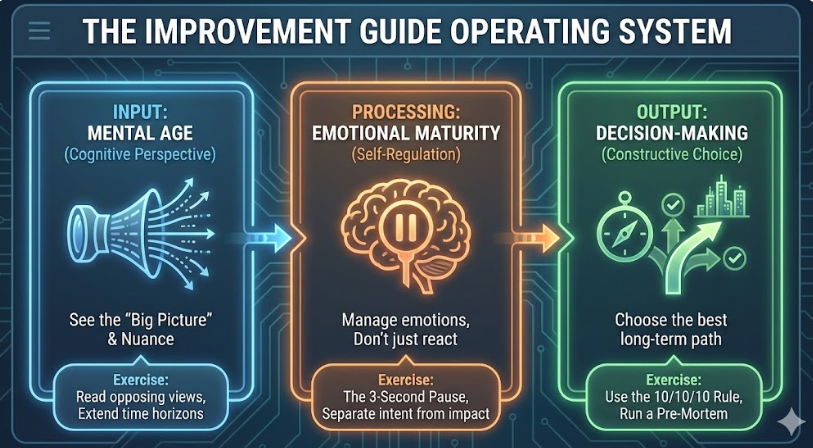
4. The 10-10-10 Rule
Ask before deciding:
“How will this choice feel in 10 minutes, 10 days, and 10 months?”
This expands perspective and reduces regret.
5. Three-Options Rule
When faced with a problem, list at least three possible solutions.
This trains your brain to think beyond black-and-white answers.
6. Post-Decision Reflection
After major decisions, journal what went well and what didn’t.
It builds insight and supports mature, long-term thinking.
Learn how your mental age influences judgment in Mental Age and Decision-Making.
Social Skills & Empathy — Strengthen Emotional Intelligence
7. Active Listening
Focus entirely on the speaker. When they finish, rephrase what you heard:
“So you felt frustrated when that happened, right?”
This builds trust and prevents misunderstanding.
8. Ask Feelings, Not Facts
Instead of “What happened?”, try “How did that make you feel?”
This encourages emotional openness and empathy.
9. Perspective Swap
Think of a disagreement. For five minutes, imagine seeing it from the other person’s point of view.
This improves empathy and reduces reactive conflict.
To dive deeper, read Ways to Improve Emotional Intelligence.
Habit Stacking — Make Growth a Lifestyle
| Habit | Frequency | Benefit |
|---|---|---|
| 5-Minute Morning Reflection | Daily | Sets emotional intention |
| Gratitude List (3 Things) | Daily | Improves positivity |
| Weekly Mood Journal Review | Weekly | Tracks progress & patterns |
| Re-take the Mental Age Test | Monthly | Measures mindset evolution |
| Mentor or Peer Check-in | Monthly | Encourages accountability |
Explore how different maturity stages progress in the Age Ranges Guide.
Tailored Focus by Mental Age Range
| Range | Focus Areas |
|---|---|
| Carefree Spirit (10-15) | Learn to pause, identify feelings, and create small routines |
| Emerging Adult (16-20) | Balance independence with responsibility; practice long-term planning |
| Balanced Individual (21-27) | Refine decision-making and deepen empathy |
| Mature Mind (28-38) | Maintain flexibility, prevent burnout, mentor others |
| Wise Elder (39+) | Stay curious and connect across generations |
You can compare your score to your physical age using the Comparison page for extra perspective.
How to Practice Emotional Growth Daily
- Pause before reacting — even five seconds changes your brain’s response.
- Use “I” statements — “I feel frustrated” instead of “You make me angry.”
- Reflect, don’t judge — treat mistakes as lessons, not labels.
- Seek feedback — emotional growth thrives in connection.
Discover how to build resilience and self-understanding in How to Improve Mental Age.
Final Takeaway
Emotional maturity is a skill — not a personality trait.
Through mindfulness, empathy, and reflection, you can align your mental age with your values and goals.
Keep growing, retake the Mental Age Test periodically, and use your results as a mirror for progress — not perfection.
- To understand the baseline for your growth, it helps to review the definition of emotional maturity.
- You can learn how cognitive patterns affect your choices by exploring the psychology section.
- Many users find motivation by reading stories from others who have improved their mindset.
- If you are unsure about specific steps in the process, our frequently asked questions can clarify them.
- Tracking your improvement is easier when you understand how to interpret your assessment results.
- To see the scientific basis for these developmental stages, check out our research methodology.
- When you feel ready to measure your progress, simply visit the homepage to retry the evaluation.