Your mental age and physical (chronological) age don’t always match — and that’s completely normal.
While physical age tracks the number of years you’ve lived, mental age reflects how emotionally mature and psychologically developed you are.
Understanding the gap between them can reveal how you think, feel, and grow as a person.
What Is Mental Age?
Your mental age measures emotional intelligence, reasoning style, and self-awareness — not IQ or education.
It shows how your mindset aligns with typical stages of psychological maturity.
You can find your own mental age by taking the Mental Age Test.
Learn the psychological theory behind it on our Methodology page.
What Is Physical Age?
Your physical age, or chronological age, is simply how long you’ve been alive.
It’s constant and measurable — unlike your mental age, which changes as you learn and evolve.
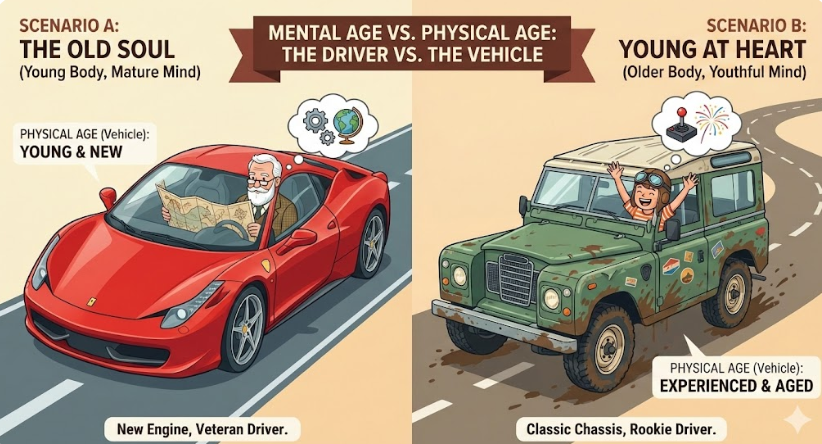
Two people can be the same physical age yet have completely different mental ages, depending on their experiences, emotional intelligence, and personality.
Discover more in What Is the Difference Between Mental Age and Chronological Age.
Why Mental and Physical Ages Differ
The difference between your mental and physical ages doesn’t mean something is wrong — it reflects your unique life journey.
Here are the main reasons the two can diverge:
1. Life Experience
Challenging experiences (loss, responsibility, or growth opportunities) often lead to a higher mental age than peers.
2. Personality Type
Creative, spontaneous personalities often retain youthful thinking — while introspective people may develop wisdom early.
3. Environment & Relationships
Supportive environments and emotional mentors encourage emotional growth, while toxic or limiting ones can slow it.
4. Emotional Intelligence
Those who practice reflection, empathy, and self-regulation advance faster in mental maturity.
Learn how to develop these skills in Ways to Improve Emotional Intelligence.
5. Cultural Factors
Different societies emphasize emotional control, independence, or social behavior differently — shaping mental maturity at different rates.
What Different Gaps Mean
| Relationship Between Ages | What It Indicates | Strengths | Growth Tips |
|---|---|---|---|
| Mental Age Lower Than Physical Age | You have a youthful, curious, and spontaneous mindset. | Creativity, openness, adaptability | Build consistency and emotional regulation. See the Improvement Guide. |
| Mental Age Equal to Physical Age | You’re well-balanced — emotionally mature and age-aligned. | Stability, empathy, self-awareness | Keep challenging yourself with new goals and learning. |
| Mental Age Higher Than Physical Age | You’re wise beyond your years — calm, responsible, and reflective. | Deep emotional insight, foresight | Stay open to spontaneity and joy. Read Can Mental Age Be Higher Than Real Age. |
To see which age range you fall into, explore the Age Ranges Guide.
Real-Life Examples
| Example | Interpretation |
|---|---|
| A 25-year-old with a mental age of 18 | Energetic and creative, but still exploring emotional balance. |
| A 30-year-old with a mental age of 35 | Emotionally mature, stable, and reflective. |
| A 40-year-old with a mental age of 28 | Youthful in energy and thinking, flexible and imaginative. |
These differences aren’t judgments — they’re insights.
Your result helps you understand where you are and how to grow.
Check your detailed results on the Results page.
How to Balance the Gap
If your mental and physical ages feel out of sync, use daily habits to realign them:
1. Practice Emotional Regulation
Use mindful breathing and journaling to respond calmly instead of reacting impulsively.
Visit the Improvement Guide for step-by-step exercises.
2. Strengthen Decision-Making
Apply the “10–10–10” rule: ask how your decision will feel in 10 minutes, 10 days, and 10 months.
Explore more in Mental Age and Decision-Making.
3. Deepen Social Awareness
Ask others how they feel, not just what they think.
See How Does Mental Age Affect Relationships to understand emotional connection dynamics.
4. Keep Learning & Reflecting
Read, journal, and retake your Mental Age Test regularly.
Growth happens through self-awareness, not age.
The Psychology Behind the Gap
Psychologists like Jean Piaget and Erik Erikson showed that cognitive and emotional development occur in stages — but not always at the same pace for everyone.
Modern emotional intelligence research confirms that emotional growth can continue long after physical maturity.
Our testing method combines these theories to give a more holistic understanding of your mindset.
Learn more on the Methodology page.
- You can clearly visualize the gap between biological years and mindset on our comparison page.
- To understand why these differences occur, it is helpful to explore the psychological factors involved.
- A major component contributing to this discrepancy is your level of emotional development.
- You might fall into one of the specific mental stages regardless of your actual birth date.
- If you want to align your mindset with your biological age, try our growth guide.
- Your final report will reveal specific traits, so be sure to analyze your detailed results.
- To find out if your mind is older or younger than your body, start the check here.