Emotional maturity is the ability to understand, manage, and express your emotions in healthy, balanced ways — especially during stress or conflict.
It’s a core part of your mental age, influencing how you think, connect, and grow.
Emotionally mature people respond thoughtfully rather than react impulsively, take responsibility for their actions, and maintain empathy even when life feels challenging.
If you’ve recently taken the Mental Age Test, your result likely reflected how emotionally mature you are compared to your physical age.
Definition of Emotional Maturity
Emotional maturity isn’t about being “serious” — it’s about emotional balance and awareness.
A person with emotional maturity can:
- Recognize their own emotions without denial or suppression
- Regulate their reactions instead of letting impulses take over
- Communicate feelings clearly and respectfully
- Accept responsibility for mistakes
- Empathize with others’ emotions and perspectives
In short, it’s not about what you feel — it’s about how you respond to those feelings.
If you’d like to know which emotional stage you’re currently in, visit the Age Ranges Guide to understand your profile better.
Why Emotional Maturity Is Important
1. Better Relationships
Emotionally mature individuals handle disagreements calmly and prioritize understanding over being right.
They listen actively, express needs clearly, and know when to apologize or compromise.
Learn more in How Does Mental Age Affect Relationships.
2. Improved Decision-Making
A mature emotional mindset allows for logical and empathetic decision-making — balancing emotion with reason.
This skill is explored deeply in Mental Age and Decision-Making.
3. Higher Emotional Intelligence (EQ)
Emotional maturity strengthens EQ — your ability to perceive, understand, and manage emotions effectively.
Explore practical methods in Ways to Improve Emotional Intelligence.
4. Reduced Stress and Anxiety
Maturity means choosing calmness over chaos.
You don’t suppress feelings — you manage them through healthy coping mechanisms like reflection, journaling, or mindful breathing.
Discover emotional regulation techniques in the Improvement Guide.
Examples of Emotionally Mature Behavior
Here are some real-world signs that show emotional maturity in action:
| Situation | Emotionally Immature Response | Emotionally Mature Response |
|---|---|---|
| Conflict | Yells or withdraws | Communicates feelings calmly |
| Criticism | Gets defensive or hurt | Reflects and looks for growth |
| Failure | Blames others | Accepts mistakes and adjusts |
| Stress | Reacts impulsively | Pauses and uses coping tools |
| Relationships | Demands attention or validation | Gives space and practices empathy |
These everyday behaviors demonstrate that emotional maturity is a learnable skill, not a personality trait.
To understand how your mental and emotional maturity align, visit the Comparison page.
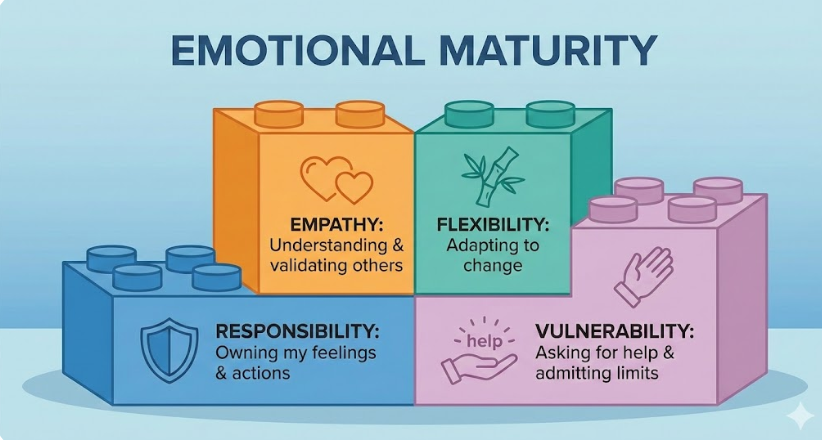
How to Build Emotional Maturity
Becoming emotionally mature is a process of self-awareness and practice.
Here are key habits to develop:
- Reflect daily: Ask, “Why did I feel that way?”
- Journal your emotions and triggers
- Take deep breaths before responding
- Replace blame with accountability
- Practice empathy in every interaction
Detailed exercises and tools to build these habits are in our Improvement Guide.
The Psychology Behind Emotional Growth
According to Jean Piaget and Erik Erikson, emotional development occurs in stages.
Each phase builds on the previous one, teaching us how to balance independence, empathy, and identity.
Our test blends these developmental models with modern emotional intelligence research, which you can explore on the Methodology page.
- You can find practical steps for personal growth in our development guide.
- It is often helpful to review the psychology behind how we process emotions.
- To understand where you fit on the spectrum, look at the standard age classifications.
- Comparing your reactions to others is easier with this detailed comparison.
- If you want to see how these traits are calculated, read about our methodology.
- Once you have completed an assessment, knowing how to read your results is crucial.
- For a quick evaluation of your current state, you can try the tool directly.