Your mental age is shaped by psychology — not luck.
It’s built upon decades of research into how humans think, feel, and grow emotionally.
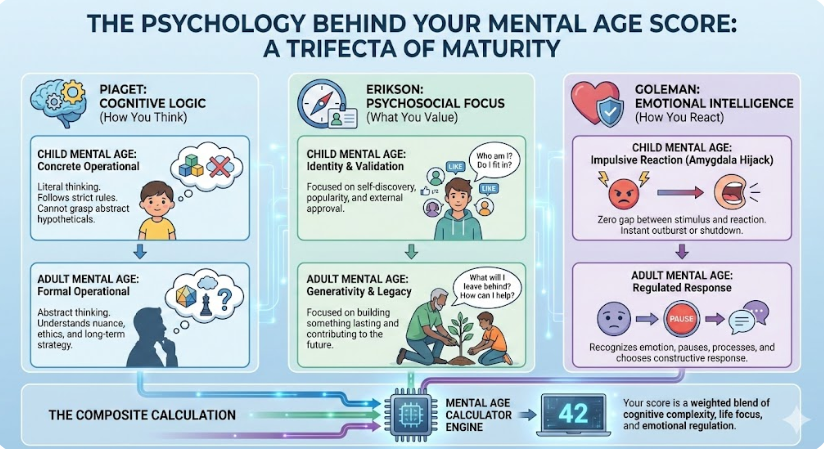
This page dives into the psychological theories that guide the Mental Age Test, featuring the groundbreaking work of Jean Piaget, Erik Erikson, and Daniel Goleman.
These theories form the foundation for understanding emotional intelligence, maturity, and decision-making — the key traits measured in your Results.
Why Psychology Matters in Measuring Mental Age
Psychology explains why two people of the same physical age can have completely different mental and emotional maturity levels.
Our test blends classical cognitive development and modern emotional intelligence research to show where you are in your personal growth journey.
If you want to understand your developmental stage, check the Age Ranges Guide.
To explore how your mindset compares to your physical age, visit the Comparison page.
And if you want to improve your mindset maturity, the Improvement Guide is your next step.
Jean Piaget — Cognitive Development Theory
Jean Piaget (1896–1980) is one of the most influential psychologists in understanding how human intelligence evolves.
He proposed that our ability to reason and solve problems develops through distinct cognitive stages — which form the foundation of mental age assessment.
Piaget’s Four Stages of Cognitive Development
- Sensorimotor (0–2 years): Learning through exploration and movement.
- Preoperational (2–7 years): Imagination and symbolic thinking begin.
- Concrete Operational (7–11 years): Logical thought and understanding cause-and-effect.
- Formal Operational (12+ years): Abstract reasoning, empathy, and long-term planning.
Our test focuses on the Formal Operational Stage, where emotional and rational reasoning merge — allowing us to measure traits like self-awareness, impulse control, and adaptability.
Related Reading:
- What Is the Difference Between Mental Age and Chronological Age
- Mental Age vs Cognitive Age
- How to Calculate Your Mental Age Scientifically
To learn how these developmental stages influence your score, explore the Methodology page.
Erik Erikson — Psychosocial Development Theory
While Piaget explained how we think, Erik Erikson focused on how we grow emotionally and socially.
He identified eight stages of psychosocial development, each defined by a key emotional challenge that shapes maturity.
Erikson’s Key Stages That Influence Mental Age
- Identity vs Role Confusion (Adolescence): Who am I and what do I stand for?
- Intimacy vs Isolation (Young Adult): How do I connect with others?
- Generativity vs Stagnation (Adulthood): What do I contribute to the world?
- Integrity vs Despair (Later Life): How do I make peace with my journey?
People who navigate these stages successfully tend to have higher mental ages, marked by confidence, self-acceptance, and empathy.
Daniel Goleman — Emotional Intelligence (EQ)
Daniel Goleman’s Emotional Intelligence Theory bridges classical psychology and modern neuroscience.
He proposed that emotional intelligence (EQ) is often more important for success and well-being than IQ.
The Five Components of EQ
- Self-Awareness: Recognizing emotions and their impact.
- Self-Regulation: Staying calm and composed under pressure.
- Motivation: Staying focused on personal growth and long-term goals.
- Empathy: Understanding and resonating with others’ emotions.
- Social Skills: Communicating and resolving conflicts effectively.
Our test assesses all five — which is why your mental age reflects not just thinking, but also emotional stability and interpersonal awareness.
Related Posts:
- Ways to Improve Emotional Intelligence
- How Does Mental Age Affect Personality
- How Does Mental Age Affect Relationships
To apply Goleman’s EQ framework in your daily life, explore exercises in the Improvement Guide.
How These Theories Work Together
Our Mental Age Model combines Piaget’s, Erikson’s, and Goleman’s principles into one integrated framework.
| Psychologist | Focus Area | What It Measures in the Test |
|---|---|---|
| Jean Piaget | Cognitive Development | Logical reasoning and problem-solving |
| Erik Erikson | Emotional & Social Growth | Identity, relationships, and self-concept |
| Daniel Goleman | Emotional Intelligence | Regulation, empathy, and communication |
This combined model allows our test to measure emotional growth from both a scientific and human perspective.
Emotional Growth in Practice
These psychological theories don’t just explain thinking — they guide behavior change.
Every time you regulate an emotion, make a thoughtful decision, or show empathy, you’re strengthening your mental maturity.
To improve these skills:
- Practice mindfulness and journaling (see the Improvement Guide)
- Learn from life challenges (explored in Why Is Mental Age Important)
- Reflect on how your relationships affect your growth (Can Mental Age Impact Relationships)
Each step moves you closer to emotional balance — the hallmark of a healthy, adaptive mind.
- To see how these theories are applied in practice, review our testing framework.
- Goleman’s work on EQ is a core component of our section on emotional intelligence.
- Erikson’s stages of development align closely with the age brackets used in this study.
- You can apply these psychological principles to your own life with our growth guide.
- Understanding these concepts helps you better interpret your personal results.
- See how different developmental stages contrast with one another on our comparison page.
- Experience how these scientific concepts come together by starting the test.