l age reveals how your mind approaches emotion, relationships, and decision-making — not your physical years.
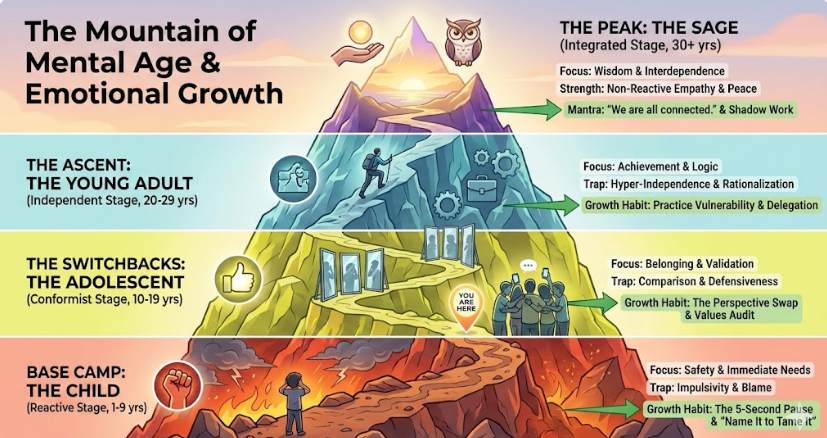
Each range below represents a distinct stage of mindset maturity, showing how you think, feel, and interact with the world.
Understanding your range helps you identify your strengths, growth areas, and actionable steps to evolve emotionally.
10–15 Years: The Carefree Spirit
Overview
You think with curiosity and playfulness — full of imagination, spontaneity, and optimism.
You live in the moment, often prioritizing excitement over responsibility. While your energy is contagious, you may struggle with focus or patience.
Key Traits
- Curious and adventurous
- Emotionally expressive and open
- Easily distracted or reactive
- Learns best through exploration
Strengths
- Creativity and enthusiasm
- Adaptable and socially engaging
- Finds joy in small moments
Growth Areas
- Developing self-discipline
- Managing emotions during frustration
- Following through on commitments
Emotional Regulation Exercise
Pause and Label Method:
Whenever you feel a strong emotion, stop for 5 seconds and name it (“I feel frustrated” / “I feel excited”).
This builds emotional intelligence and awareness.
Decision-Making Tip
Ask yourself before acting:
“What might happen if I wait one day before deciding?”
This simple reflection encourages maturity over impulse.
Social Skill Exercise
In your next conversation, try listening 70% and speaking 30%.
It helps you develop empathy and patience.
Learn how age and behavior interact in our guide on the difference between mental age and chronological age.
If you want to strengthen consistency and focus, visit the Improvement Guide.
16–20 Years: The Emerging Adult
Overview
You’re in a stage of self-discovery, exploring independence and emotional growth.
You’re curious, expressive, and open to experiences — but still learning to balance emotion and logic.
Key Traits
- Emotionally aware yet reactive
- Seeks freedom and identity
- Learns through experience and feedback
Strengths
- Adaptable and curious
- Passionate and empathetic
- Great at connecting with others
Growth Areas
- Building emotional stability
- Managing frustration and criticism
- Strengthening long-term focus
Emotional Regulation Exercise
10-Breath Reset:
Take 10 slow, deep breaths when overwhelmed.
It calms your nervous system and improves response control.
Decision-Making Tip
Try the “3-Option Rule” — before deciding, list three possible actions.
This broadens perspective and encourages balanced thinking.
Social Skill Exercise
Ask deeper questions like, “What’s something you’ve learned about yourself lately?”
It builds stronger emotional connections.
Understand why developing emotional intelligence matters in Why Mental Age Is Important.
To compare your maturity stage, check the Mental Age vs Maturity Test.
21–27 Years: The Balanced Individual
Overview
You’ve developed emotional awareness and thoughtful reasoning.
You value balance — between logic and empathy, work and rest, self and others.
Key Traits
- Emotionally intelligent and reflective
- Consistent and empathetic
- Strives for purpose and understanding
Strengths
- Stable emotional regulation
- Thoughtful communication
- Reliable and grounded mindset
Growth Areas
- Avoiding perfectionism
- Strengthening confidence under pressure
- Trusting intuition
Emotional Regulation Exercise
Thought Journal:
Each day, note one situation that made you emotional.
Ask: What caused it? How did I respond? What could I improve?
Over time, this strengthens self-awareness and control.
Decision-Making Tip
Use the 10–10–10 rule:
How will this decision feel in 10 minutes, 10 days, and 10 months?
It expands foresight and emotional maturity.
Social Skill Exercise
Practice empathic mirroring — repeat back what someone says to validate their feelings.
Example: “It sounds like you’re feeling unsure about that.”
For deeper insights, read How to Interpret Your Mental Age Test Results.
To keep improving emotional strength, see How to Improve Mental Age.
28–38 Years: The Mature Mind
Overview
You possess emotional depth and self-awareness.
You think calmly under stress, value stability, and often act as a mentor or leader to others.
Key Traits
- Emotionally balanced and wise
- Great listener and problem-solver
- Prefers depth over drama
Strengths
- Empathy and perspective
- Strategic decision-making
- Consistency and reliability
Growth Areas
- Staying flexible amid change
- Preventing burnout
- Reconnecting with curiosity and play
Emotional Regulation Exercise
Reframe the Situation:
When something goes wrong, ask: “What can I learn from this?”
This reframes frustration into self-growth.
Decision-Making Tip
Try Reverse Perspective Thinking:
“If someone I admire faced this decision, how would they respond?”
This detaches emotion from the process and encourages wisdom.
Social Skill Exercise
Offer mentorship or guidance to someone starting out in life or work.
It strengthens empathy and reinforces your own self-awareness.
Explore how maturity develops in Mental Age vs Emotional Age.
You can also learn how thinking evolves with age in How Mental Age Affects Personality.
39–50+ Years: The Wise Elder
Overview
You’ve reached a stage of emotional mastery and perspective.
You value peace, patience, and meaningful connection over material achievement.
You see life as a cycle of learning and giving back.
Key Traits
- Calm, patient, and reflective
- Wise and intuitive
- Emotionally grounded
Strengths
- Wisdom through experience
- Deep empathy and emotional clarity
- Leadership through compassion
Growth Areas
- Staying open to new ideas
- Maintaining curiosity
- Sharing wisdom actively with others
Emotional Regulation Exercise
Gratitude Reflection:
Each night, write three things you appreciated about your day.
It cultivates perspective, calm, and optimism.
Decision-Making Tip
Before choosing, ask:
“Does this decision align with my values?”
It promotes integrity and inner harmony.
Social Skill Exercise
Share lessons from your life story — it connects generations and keeps your empathy active.
Learn how emotional wisdom shapes relationships in Can Mental Age Impact Relationships.
See how reflection leads to self-growth in Benefits of Taking a Mental Age Test.
Universal Exercises to Improve Emotional Maturity
Regardless of your mental age, these practices help strengthen emotional growth:
| Focus Area | Exercise | Benefit |
|---|---|---|
| Emotional Regulation | 5-minute breathing meditation | Improves calm and patience |
| Decision-Making | Write pros and cons before choosing | Encourages logical reflection |
| Social Awareness | Ask others how they feel (not what they think) | Builds empathy and understanding |
| Reflection | Journal “What did I learn about myself today?” | Enhances self-awareness |
Continue growing your mindset with the Improvement Guide and explore techniques from Ways to Improve Emotional Intelligence.
The Psychology Behind These Age Ranges
Our framework is inspired by Jean Piaget’s Cognitive Development Theory,
Erik Erikson’s Psychosocial Stages, and modern Emotional Intelligence research by Daniel Goleman.
Each mental age category combines reasoning, emotion, and social development patterns to create a holistic picture of your maturity.
To explore the science in depth, visit the Methodology page.
Continue Your Journey
| Goal | Recommended Page |
|---|---|
| Understand your results | Results Page |
| Learn how to grow maturity | Improvement Guide |
| Explore psychology insights | Psychology Page |
| Compare mindset stages | Comparison Page |
| Retake the quiz | Mental Age Test |
Final Thought
Your mental age is not a score to judge yourself — it’s a mirror that helps you understand your current mindset.
With reflection, practice, and openness, your emotional maturity can evolve at any stage of life.
- You can find specific activities to help you grow in our improvement guide.
- To understand the science behind these classifications, review the psychology overview.
- It is helpful to see how your traits match up against others using the comparison tool.
- Deepen your understanding of personal growth by reading about emotional maturity.
- If you are curious about how these specific groups were determined, check the methodology page.
- You can see how these traits influence your outcome by looking at the results breakdown.
- To see which category currently fits you best, take the test here.