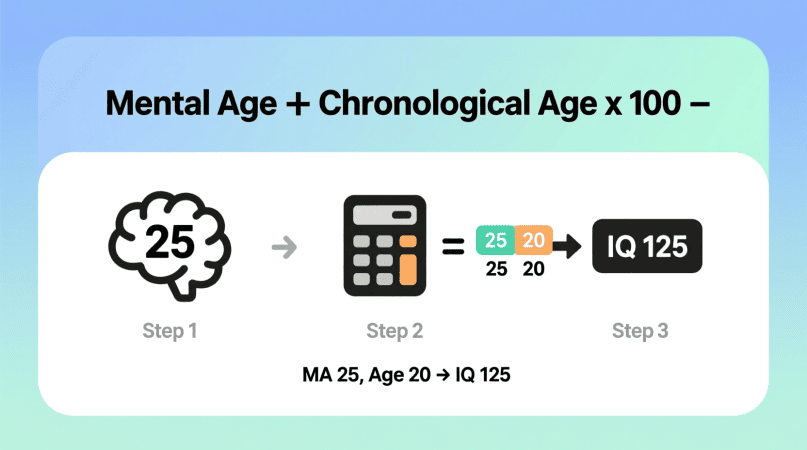
When people hear about mental age, they often wonder: “How old is my mind compared to my actual age?” Psychologists first introduced this idea over a century ago to measure how a person’s intellectual ability compares to the average ability at different ages.
In this guide, you’ll learn:
- What mental age means compared to chronological age
- The classic formula used to calculate mental age
- Step-by-step examples for children, teens, and adults
- Why the formula works better for children than for adults
- FAQs that answer common questions
For a quick self-check, try the free Mental Age Checker.
What Is Mental Age?
Mental age describes the intellectual level at which a person is functioning, compared to the average ability of people at a certain chronological age.
- If a 10-year-old child solves problems like the average 12-year-old, their mental age is 12.
- If a 16-year-old performs like a typical 13-year-old, their mental age is 13.
It’s important to note that mental age is not the same as emotional maturity or social age.
What Is Chronological Age?
Chronological age is the actual time a person has lived since birth. It is measured in years, months, and days.
How to calculate chronological age:
- Write down your birth date.
- Subtract it from today’s date.
- Count the difference in years, then months, then days.
Example:
- Birth date: June 10, 2010
- Current date: September 19, 2025
- Chronological age = 15 years, 3 months, 9 days
To see how maturity compares across emotions, explore mental age vs emotional age.
Formula to Calculate Mental Age
The classic IQ formula, introduced by Alfred Binet and William Stern, connects mental age and chronological age: IQ=Mental AgeChronological Age × 100IQ = \ frac {Mental \ Age}{Chronological\ Age} \times 100
Rearranged to solve for mental age: Mental Age = IQ × Chronological Age100Mental \ Age = \ frac {IQ \times Chronological\ Age}{100}
Learn how our mental age test works to understand the formula and accuracy behind your results.
Step-by-Step Examples
- Example 1 – Child:
Chronological Age = 10 years, IQ = 120 MA=120×10100=12MA = \frac{120 \times 10}{100} = 12 ✅ The child’s mental age is 12 years. - Example 2 – Teenager:
Chronological Age = 16 years, IQ = 85 MA=85×16100=13.6MA = \frac{85 \times 16}{100} = 13.6 ✅ The teen’s mental age is about 14 years. - Example 3 – Adult:
Chronological Age = 30 years, IQ = 110 MA=110×30100=33MA = \frac{110 \times 30}{100} = 33 ⚠️ While this suggests a mental age of 33, psychologists caution that the formula is less meaningful for adults because intellectual growth doesn’t continue year by year after childhood.
For a full overview of how intelligence and maturity relate, explore is mental age the same as IQ.
Ratio IQ vs Deviation IQ
| Feature | Ratio IQ (Classic) | Deviation IQ (Modern) |
|---|---|---|
| Formula | MA ÷ CA × 100 | Comparison to age-normed average |
| Works Best For | Children | All ages |
| Limitation | Not valid for adults | Still influenced by test design |
Today’s IQ tests mostly use deviation IQ, which compares performance to peers of the same age group rather than converting scores to a mental age.
Read how to calculate your mental age online for a simple step-by-step version.
Misconceptions and Limitations
- Mental age is not emotional maturity – you can be intellectually advanced but emotionally young.
- The formula isn’t reliable for adults – because cognitive growth plateaus, and IQ is measured differently.
- Online tests are for insight, not diagnosis – fun and reflective, but not medical assessments.
FAQs
1. How do you calculate mental age of a person?
Multiply IQ by chronological age and divide by 100.
2. What is the difference between mental age and chronological age?
Chronological age is actual age in years; mental age is intellectual performance compared to averages.
3. Can adults use the mental age formula?
Not accurately — it was designed for children. Adults are measured with deviation IQ.
4. What does it mean if mental age is higher than chronological age?
It suggests advanced intellectual ability for that age group.
5. Do online mental age quizzes give real results?
They can provide insights, but only standardized tests give accurate measures.
- A step-by-step explanation is provided in how to calculate your mental age.
- The scientific background behind formulas is explained in how to calculate mental age scientifically.
- How these scores relate to thinking style is explored in mental age and decision making.
- You can generate your own number using the mental age calculator.
- The meaning of each range is outlined in age ranges.
- Examples of how people use these results appear in how do you act according to your mental age.