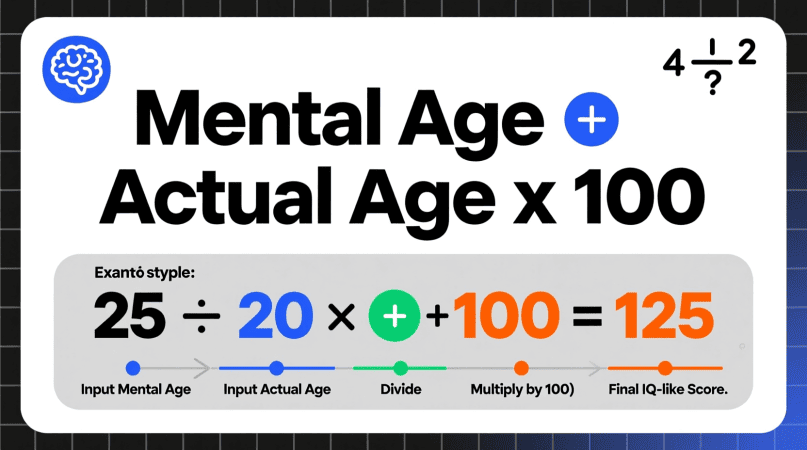
Many people wonder, “How old is my mind compared to my actual age?” That’s where the concept of mental age comes in. Psychologists once used it to compare a person’s intellectual performance to the average ability of different age groups. Even though modern IQ tests have evolved, the idea still helps people think about how their mind works.
In this guide, you’ll learn:
- What mental age means vs chronological age
- The formula used to measure mental age
- Step-by-step examples across different ages
- Why the formula works best for children, not adults
- FAQs that clear up common confusion
What Is Mental Age?
Mental age refers to the cognitive level at which a person is functioning compared to the average performance of people at different chronological ages.
- If a 10-year-old performs like the average 12-year-old, their mental age is 12.
- If a 15-year-old solves problems at the level of a 13-year-old, their mental age is 13.
It’s a way of expressing intellectual performance, but it does not describe emotional maturity or personality.
Try our Online mental age check to measure your mental age instantly with accurate results.
What Is Chronological Age?
Chronological age is simply your actual age—the time since birth measured in years, months, and days.
Example:
- Birth date: June 10, 2010
- Current date: September 19, 2025
- Chronological age = 15 years, 3 months, 9 days
Knowing both chronological age and IQ is important if you want to calculate mental age accurately.
The Formula for Measuring Mental Age
The classic IQ formula connects mental age (MA) and chronological age (CA): IQ=MACA×100IQ = \frac{MA}{CA} \times 100
Rearranged to find mental age: Mental Age=IQ×Chronological Age100Mental\ Age = \frac{IQ \times Chronological\ Age}{100}
This simple equation shows how mental age can be estimated from an IQ score and chronological age.
Step-by-Step: How to Measure Mental Age
- Take a reliable IQ test – standardized assessments like Stanford–Binet or WISC provide accurate scores.
- Calculate chronological age – work out your exact age in years and months.
- Apply the formula – use the equation to convert IQ and age into a mental age.
- Interpret the result – compare whether mental age is higher, equal, or lower than chronological age.
Explore how to test mental age for a step-by-step look at different testing methods.
Worked Examples
- Child Example:
Chronological Age = 10 years, IQ = 120 MA=120×10100=12MA - Teen Example:
Chronological Age = 16 years, IQ = 85 MA=85×16100=13.6MA - Adult Example:
Chronological Age = 30 years, IQ = 110 MA=110×30100=33MA
This shows 33, but psychologists note the formula loses meaning for adults since intellectual growth levels off.
Once you’ve completed the quiz, visit your personalized results page to review your score.
Ratio IQ vs Deviation IQ
| Feature | Ratio IQ (Classic) | Deviation IQ (Modern) |
|---|---|---|
| Formula | MA ÷ CA × 100 | Comparison to age-normed average |
| Works Best | Children | All ages |
| Limitation | Becomes less valid in adults | Still test-dependent |
Today, most IQ tests use deviation IQ, which compares performance to peers of the same age group rather than turning scores into a “mental age.”
Limitations and Misconceptions
- Not the same as maturity – mental age doesn’t measure emotional or social growth.
- Not reliable for adults – formula was designed for children.
- Online quizzes are for insight only – fun and thought-provoking but not diagnostic.
Read how to calculate mental age of a person for formula-based approaches.
FAQs
1. How do you measure mental age?
By combining IQ and chronological age using the formula: Mental Age = (IQ × Chronological Age) ÷ 100.
2. What’s the difference between mental and chronological age?
Chronological age is actual years lived; mental age is intellectual performance compared to averages.
3. Can adults measure mental age this way?
Not accurately—modern IQ testing uses deviation IQ.
4. What does it mean if mental age is higher than actual age?
It suggests advanced cognitive ability for that age group.
5. Are mental age quizzes accurate?
They provide insights but don’t replace professional assessments.
- A clear explanation of how measurements are structured can be found in our methodology.
- Understanding what different scores represent is easier with the age ranges guide.
- The emotional traits behind these measurements are explained in emotional maturity.
- You can see a real example by taking the mental age test.
- Many readers also explore how age relates to thinking in mental age vs chronological age.
- Practical ways to apply what you learn are shared in how to improve mental age.