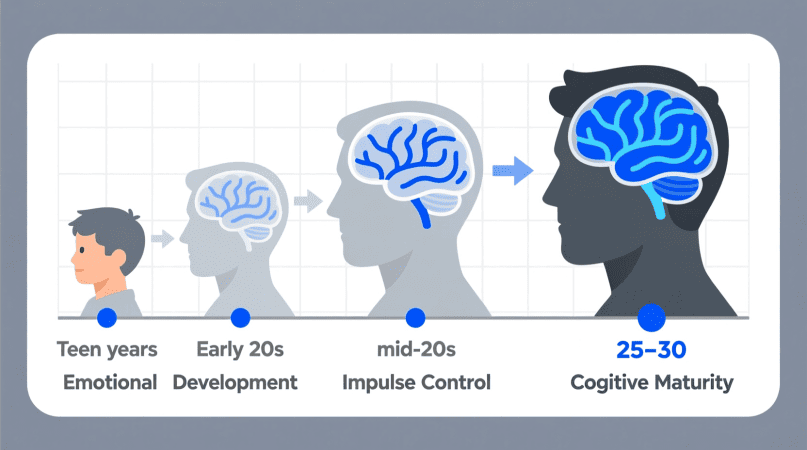
When people ask “what age does a man fully mentally mature?”, the answer isn’t as simple as a single number. Maturity can mean different things — biological brain development, emotional growth, and social responsibility. While research shows men’s brains finish key development in their mid-20s, emotional and social maturity often take longer and depend on life experiences.
Let’s explore what the science and psychology say about male maturity.
Try the free Mental Age Checker to see your mental outlook beyond just your biological age.
Brain Development: The Biological Side of Maturity
- The prefrontal cortex, the brain region responsible for judgment, planning, and impulse control, continues developing until about age 25.
- This explains why risk-taking and poor decision-making are more common in teenage and early adult years.
- After the mid-20s, most men have the biological tools needed for self-control and rational thinking.
In short, biological maturity arrives in the mid-20s, but that’s not the full picture.
If you’re interested in relationships, explore how does mental age affect relationships.
Emotional Maturity: A Lifelong Process
Emotional maturity is less about age and more about self-awareness and responsibility. It includes:
- Recognizing and regulating emotions
- Handling stress and conflict constructively
- Showing empathy and respect in relationships
- Taking accountability for one’s actions
Psychologists note that emotional maturity often develops through life milestones — career stability, long-term relationships, parenting, and overcoming setbacks. For many men, this growth deepens in their 30s and 40s.
Read what age does a woman mature mentally? to see how the timeline differs between genders.
Social and Cultural Maturity
Cultural expectations also influence what “maturity” means.
- In some societies, maturity is tied to providing for family or achieving career stability.
- In others, it’s measured by emotional openness and personal growth.
- Surveys sometimes claim men don’t fully mature until their early 40s — though these are perceptions, not hard science.
This shows maturity isn’t just biological; it’s also shaped by society and life roles.
Quick Comparison: Maturity Milestones in Men
| Type of Maturity | Typical Age Range | Key Traits |
|---|---|---|
| Biological (Brain) | ~25 years | Judgment, impulse control, decision-making |
| Emotional | 25–40+ years | Empathy, accountability, emotional regulation |
| Social / Cultural | 30s–40s (varies) | Responsibility, stable roles, contribution |
Why Some Men Mature Later
Not all men follow the same timeline. Factors that may delay maturity include:
- Lack of stable role models
- Prolonged dependence (financial or emotional)
- Avoidance of responsibility
- Mental health challenges
Conversely, men who face early responsibilities often mature earlier than average.
Check signs of emotional and mental maturity to recognize when true maturity is reached.
Signs a Man Is Mentally Mature
- Consistently follows through on commitments
- Balances independence with emotional openness
- Accepts constructive criticism without defensiveness
- Maintains healthy relationships built on respect
- Plans for the future rather than living only in the moment
If these traits sound familiar, maturity has likely taken root — regardless of age.
Key Takeaways
- Brain maturity: Men’s brains complete major development by ~25.
- Emotional maturity: More gradual, often developing well into the 30s or 40s.
- Social maturity: Shaped by culture, responsibilities, and life stages.
- No single age fits all: Every man’s journey is influenced by experience and environment.
You can explore how mental age vs real age reveals surprising personality traits.
FAQs: What Age Does a Man Fully Mentally Mature?
1. Is 25 the age when men are fully mature?
Biologically, yes — but emotional and social maturity often take longer.
2. Do men really mature later than women?
Research suggests women often develop emotional regulation earlier, but maturity is individual.
3. Can men mature earlier than 25?
They may show responsibility younger, but brain development continues into the mid-20s.
4. Why do some men seem immature in their 30s or 40s?
Emotional maturity depends on experience, not just age. Avoidance of responsibility can delay it.
5. How can a man become more mature?
Through accountability, empathy, consistent effort, and openness to growth
- Male development over time is closely tied to levels of emotional maturity.
- These changes are often reflected differently across age ranges.
- The psychology behind maturity and behavior is covered in our psychology hub.
- Men interested in self-reflection often try the mental age test.
- How maturity scores are created is explained in our methodology.
- After completing the test, personal insights appear on the results page.