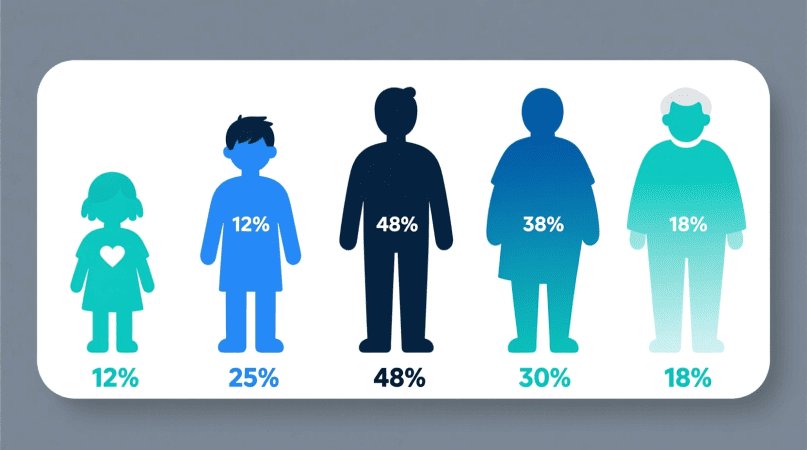
Mental health challenges can affect people of all ages, but some groups are more vulnerable than others. Research consistently shows that adolescents and young adults experience the highest rates of mental health issues, while older adults report lower prevalence overall.
Understanding which age groups are most affected helps parents, educators, policymakers, and individuals take action early.
Start with our mental age test free to see how your mental and emotional balance compares to your age group.
Mental Health by Age: A Quick Overview
- Adolescents (12–17): Nearly 1 in 2 teens experiences a mental health disorder at some point. Anxiety, depression, and eating disorders are most common.
- Young Adults (18–25): The highest prevalence of mental illness is found here—about 1 in 3 experiences a mental health condition each year.
- Adults (26–49): Around 1 in 4 report mental illness annually, with stress, depression, and substance use common.
- Older Adults (50+): Rates decline, though depression, anxiety, and dementia-related issues remain important.
Learn the science behind psychology and how age influences mental health trends.
Why Adolescents and Young Adults Are Most Affected
1. Brain Development
The brain continues developing until about age 25. This makes teens and young adults more vulnerable to disorders like anxiety, depression, and bipolar disorder.
2. Life Transitions
Exams, career uncertainty, new responsibilities, and relationship changes all add stress during late teens and early 20s.
3. Social and Cultural Pressures
Social media exposure, peer comparison, and shifting societal expectations can amplify anxiety and depression in younger populations.
4. Stigma and Lack of Care
Even though issues are common, many young people don’t receive treatment. This can make conditions appear more severe in this age group.
Visit age ranges to see how mental and emotional characteristics vary across life stages.
Most Common Disorders by Age Group
| Age Group | Common Mental Health Issues | Notes |
|---|---|---|
| 12–17 (Teens) | Anxiety, depression, eating disorders, ADHD | Early onset, often overlooked as “growing pains.” |
| 18–25 (Young Adults) | Depression, anxiety, bipolar disorder, substance use | Peak vulnerability, highest prevalence of any mental illness. |
| 26–49 (Adults) | Stress disorders, depression, substance abuse | Balancing work, family, and financial pressures. |
| 50+ (Older Adults) | Depression, anxiety, dementia-related issues | Rates lower, but linked to physical health and isolation. |
Severity vs Prevalence
While young adults (18–25) report the highest prevalence, severity matters too:
- Serious Mental Illness (SMI) affects about 1 in 8 young adults, more than any other age group.
- Older adults may report fewer cases, but untreated depression or dementia can still lead to severe outcomes.
Global vs National Differences
- In the U.S., young adults consistently rank highest for both prevalence and severity.
- WHO data shows adolescents worldwide face a heavy burden: about 1 in 7 adolescents (10–19) lives with a mental health disorder.
- Access to care, stigma, and cultural factors influence how rates appear in different regions.
Discover how mental age and decision-making are connected when it comes to handling stress.
FAQs on Mental Health by Age
1. What age group has the highest prevalence of mental illness?
Young adults (18–25) consistently show the highest prevalence, followed by adolescents.
2. Are teens or young adults more vulnerable?
Both groups are highly affected, but prevalence peaks in the 18–25 range.
3. Why do older adults have fewer reported issues?
Some disorders decline with age, and reporting differences may mask problems like depression or anxiety in seniors.
4. Which disorders affect teens the most?
Anxiety and depression are the most common among adolescents, followed by ADHD and eating disorders.
5. Has the rate of mental illness in young people increased?
Yes—especially post-COVID, studies show rising rates of anxiety and depression in teens and young adults.
Differences between generations become clearer when viewed through age ranges.
Many trends are influenced by levels of emotional maturity across life stages.
The science behind these patterns is explained in our psychology section.
You can compare personal traits by taking the mental age test.
For a deeper look at how scores are calculated, see our methodology.
Once you finish the test, your personalized insights appear on the results page.